Probe and Scan
Detect debug probes, enumerate JTAG chains, and identify connected chips by IDCODE. Supports DAP-Link, ST-Link, J-Link, and FTDI-based adapters through OpenOCD.
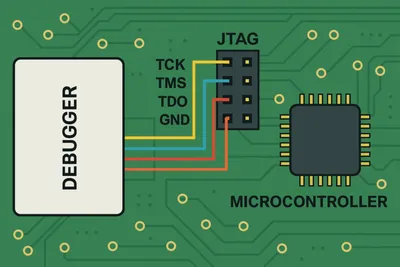
Probe and Scan
Detect debug probes, enumerate JTAG chains, and identify connected chips by IDCODE. Supports DAP-Link, ST-Link, J-Link, and FTDI-based adapters through OpenOCD.
Memory and Registers
Read and write memory with hexdump formatting, access all CPU registers, and search memory for byte patterns. Alignment and range validation built in.
SVD Peripheral Decoding
Load CMSIS SVD files to decode peripheral registers down to individual bitfields. See exactly what GPIOA, USART1, or RCC are doing without consulting the datasheet.
Flash Programming
Program firmware images (.bin, .hex, .elf) with erase and verify steps, progress reporting, and file validation. Safe by default.
# Install and runuvx mcjtag
# Or with auto-spawned OpenOCDOPENOCD_CONFIG=openocd-daplink-swd.cfg uvx mcjtag
A typical first session looks like this:
probe_diagnostics() # verify everything works (9-point health check)jtag_scan() # see what's on the chaintarget_state() # check if halted or runningread_memory("0x08000000", 4) # read the vector tableread_registers() # see CPU stateThe LLM sees structured responses for each call — addresses, hex values, decoded bitfields, formatted hexdumps — and can reason about the hardware state from there.
| Category | Tools | Purpose |
|---|---|---|
| Connection | connect, start_openocd, disconnect | Connect to or spawn OpenOCD, tear down sessions |
| Diagnostics | probe_diagnostics | 9-point health check of probe, target, and capabilities |
| Target | target_state, target_control | Halt, resume, step, reset, query execution state |
| Memory | read_memory, write_memory, search_memory | Read with hexdump, write (SRAM-safe), byte pattern search |
| Registers | read_registers, write_register | Read all or specific CPU registers, write individual registers |
| Flash | flash_info, flash_program | Bank topology, program firmware with erase/verify |
| JTAG | jtag_scan, jtag_shift | Chain enumeration, raw IR/DR scan operations |
| SVD | svd_inspect | Load SVD files, list peripherals, decode register bitfields |
| Raw | raw_command | Direct OpenOCD TCL command escape hatch |
Plus 7 resources for polling live state without tool calls (jtag://target/state,
jtag://registers/all, jtag://flash/banks, and more) and 5 prompts that guide
the LLM through common workflows like crash debugging and chip identification.
mcjtag is built for use alongside safety-critical firmware. It ships with conservative defaults that prevent accidental damage to your target:
raw_command mode. Flash writes, memory
writes, resets, and TCL metaprogramming are caught by a deny-list.Hero image: Arshon Technology